The Overview
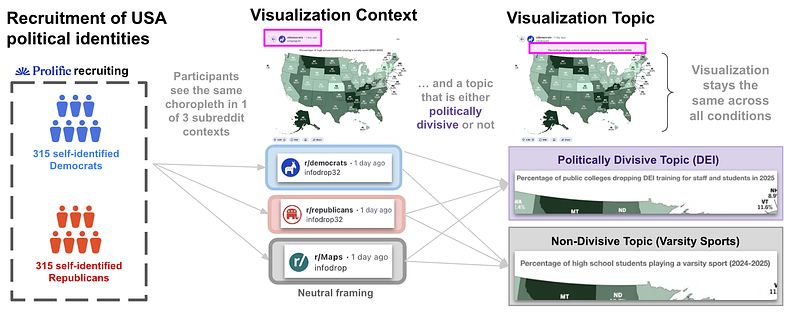
We examine how online community context shapes credibility judgments of data visualizations. In a controlled study, participants viewed identical visualizations in simulated Reddit posts from r/democrats, r/republicans, or r/maps.
Approach
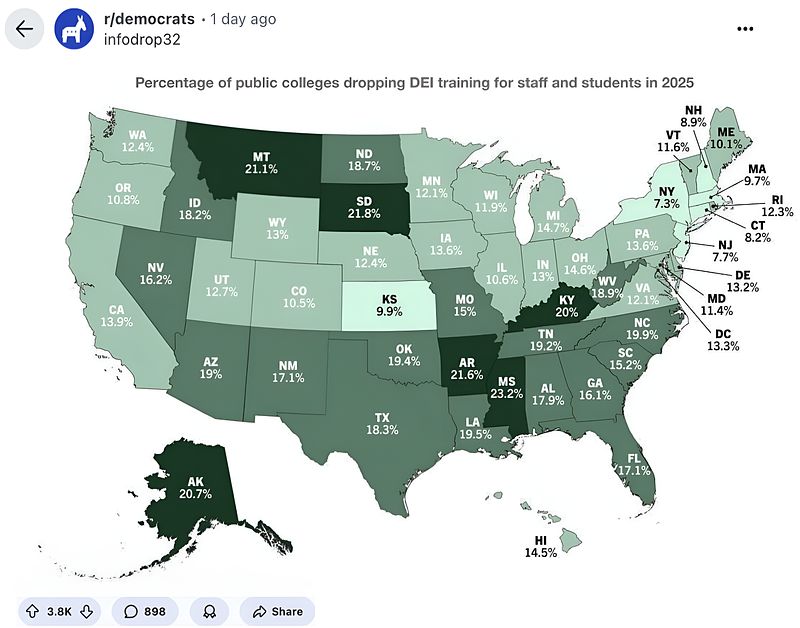
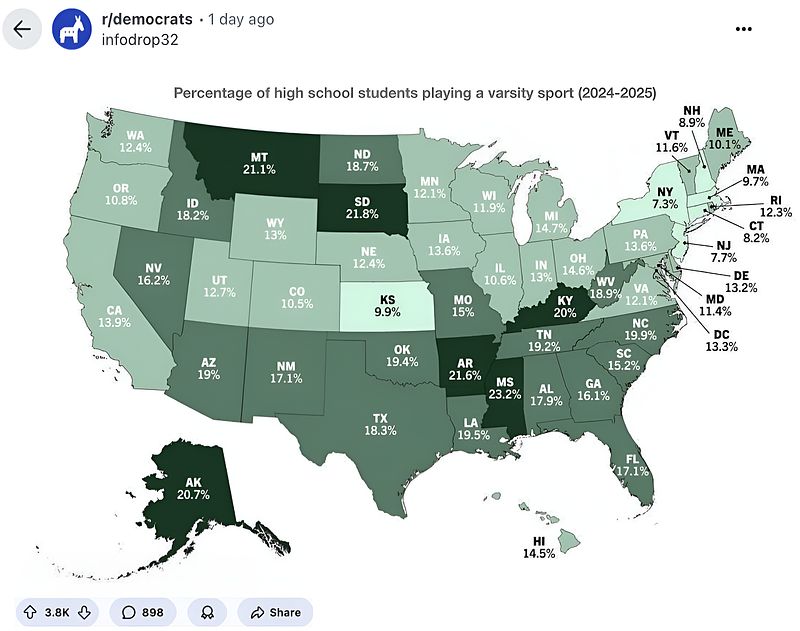
We deployed a survey of both open response and multiple choice questions on Prolific. Participants viewed one of two visualization topics (political: DEI training in colleges; non-political: varsity sports participation) within one of three subreddit contexts (left-leaning: r/Democrats; right-leaning: r/Republicans; neutral: r/Maps).
What We Found
Our findings suggest that where a visualization is shared shapes how it is believed and what viewers take away from it.
- We find that participants rate the same map as more trustworthy in ideologically aligned environments, but only when its topic is politically divisive.
- This held even among participants who could not recall the community, suggesting that it can operate below conscious awareness.
- Misalignment also shapes more than trust: for political topics, it increases support for the chart’s topic.
- Regardless of alignment, people maintained the chart was unbiased, even while doubting that it told the whole story.
Themes
Where a visualization is posted gives trust signals
"The only thing influencing my responses was this chart being shared under the Democrats subreddit on Reddit. They are biased and they lie"
Even situated data is perceived as unbiased
"I don’t see any way to call factual data 'biased'"
"Charts can’t really be biased if it’s facts & numbers and they’re correct"
Prior knowledge plays a role in trust even when surrounding cues as present
"The chart matches what I understand about the United States, so I think it is correct"
Whats Next?
This work is currently under review.
This project also raised new questions I want to pursue including how these effects hold up once we factor in more of the real context people encounter (such as comments) which may shape trust in a visualization in a similar way to the surrounding community.
This project also raised new questions I want to pursue including how these effects hold up once we factor in more of the real context people encounter (such as comments) which may shape trust in a visualization in a similar way to the surrounding community.
Collaborators
This work was done in collaboration with Alice Goldfarb (University of Colorado), Prof Emily Wall (Emory University),, Prof Evan Peck (University of Colorado).